Recipe Management System
Recipe Management System: Turn Your Recipes into Scalable Formulas

Managing recipes is not only about saving ingredient lists. For anyone working with food, sauces, spice blends, seasonings, or product development, a recipe needs to be organized, measurable, repeatable, and easy to improve over time.
This is what ZestyHut’s Recipe Management System is built for.
ZestyHut helps users turn their own recipes into structured formulas that can be scaled, costed, organized, and version-controlled. Instead of keeping recipes in notebooks, spreadsheets, screenshots, or scattered files, users can manage everything in one smart workspace.
Whether you are developing a seasoning blend, sauce recipe, restaurant formula, or food product concept, ZestyHut gives you a clearer way to manage your recipes from the first version to future improvements.
What Is the Recipe Management System?
The Recipe Management System is the workspace inside ZestyHut where users can add, organize, calculate, and manage their own recipes.
Users can enter a recipe manually, add ingredients, define quantities, choose measurement units, write preparation instructions, and organize the recipe under a specific category.
Once the recipe is entered, ZestyHut turns it into a structured formula. This means the recipe becomes easier to calculate, scale, review, and improve.
The system is designed for anyone who wants better control over recipes and formulas, including chefs, food entrepreneurs, restaurants, spice shops, product developers, private label brands, and growing food businesses.
Add Your Own Recipes
With ZestyHut, users can add their own recipes directly into the system.
A user can create a recipe by entering important details such as:
- Recipe name
- Category
- Measurement unit
- Ingredients
- Ingredient quantities
- Preparation instructions
- Raw materials
- Cost per material
For example, a user can create a recipe called Mayonnaise Recipe, place it under a category such as Sauces, choose Kilogram as the measurement unit, and start adding all required raw materials.
This gives users a clean and organized way to store recipes in a professional format.
Organize Recipes by Category
ZestyHut allows users to organize recipes under categories.
Categories help users keep recipes structured and easy to find. A user can use existing categories or create new ones depending on their work.
For example, categories can include:
- Sauces
- Spice blends
- Seasonings
- Marinades
- Arabic spices
- American spices
- Custom product lines
If a category does not already exist, the user can create a new one and save it for future recipes.
This makes the recipe library easier to manage as the number of formulas grows.
Manage Raw Materials
Inside the Recipe Management System, users can manage raw materials and use them across different recipes.
When adding a recipe, the user can select existing raw materials from the system or add new raw materials when needed.
A raw material can include:
- Material name
- Measurement unit
- Cost per unit
For example, if a user wants to add oil to a recipe and it does not already exist in the raw material list, they can create it as a new raw material, choose the unit such as kilogram, add the cost per kilogram, and then use it inside the recipe.
This makes future recipe creation faster and more accurate because the raw materials are stored and ready to be reused.
Add Preparation Instructions
A recipe is not only about ingredients and quantities. The preparation method is part of the formula.
ZestyHut allows users to add preparation instructions or SOP-style steps directly inside the recipe.
These instructions can explain how the recipe should be prepared, mixed, blended, cooked, stored, or handled.
This helps keep the recipe clear and repeatable, especially when more than one person may need to follow the same formula.
Convert Recipes into Scalable Formulas
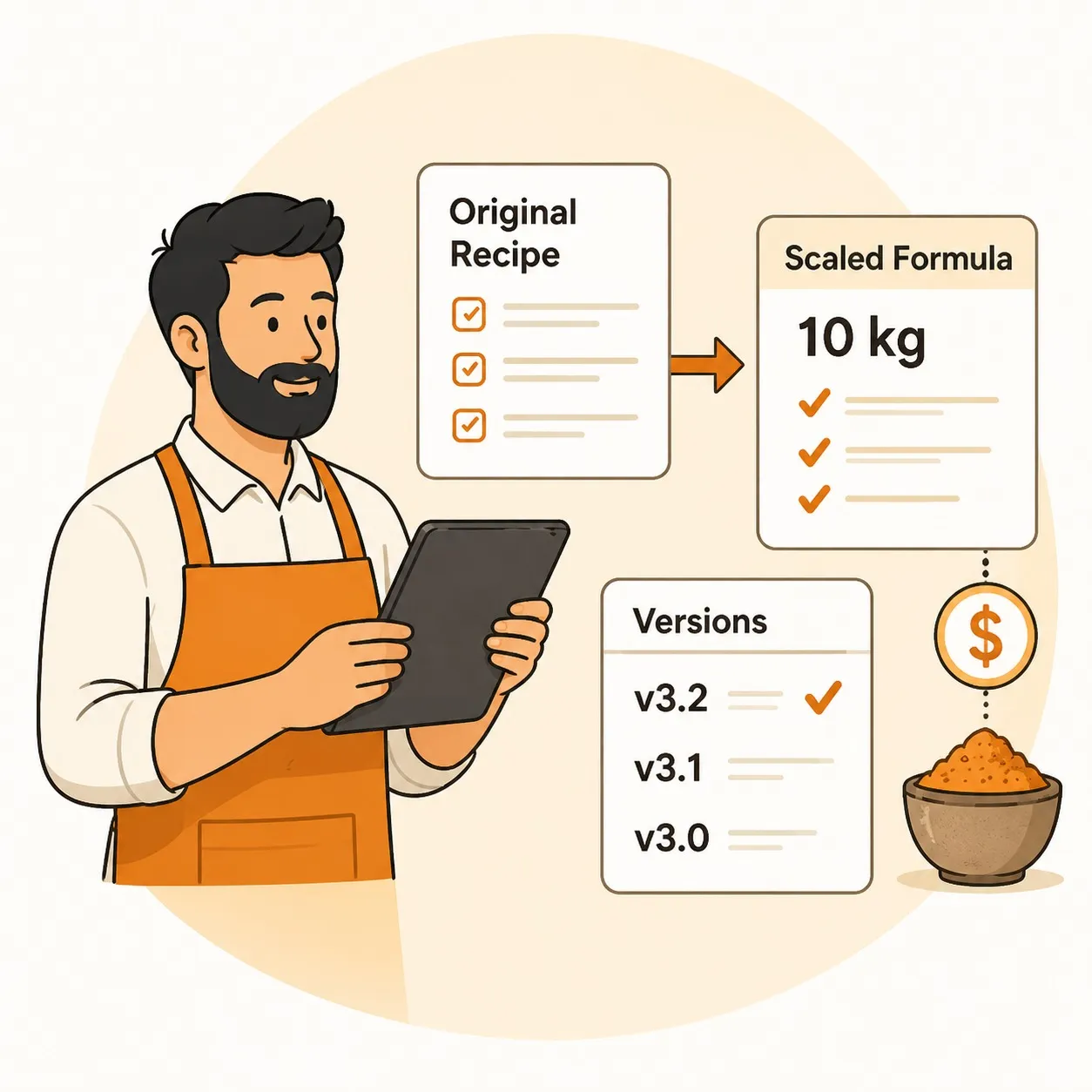
One of the most important features of the Recipe Management System is that it turns a recipe into a scalable formula.
After the user enters the ingredients and quantities, ZestyHut understands the relationship between the ingredients and keeps the balance of the recipe.
For example, if a recipe is originally built for 16 kilograms, the user can calculate the same recipe for 38 kilograms, 80 kilograms, or any other quantity.
The system recalculates every ingredient automatically while keeping the same formula balance.
This means users do not need to manually calculate every ingredient again when they want to change the recipe size.
Calculate Recipe Cost
ZestyHut also helps users understand the cost of their recipes.
When raw materials have costs inside the system, the Recipe Management System can calculate the cost of each ingredient, the total recipe cost, and the cost per unit.
For example, if a recipe contains salt, onion powder, starch, oil, and white pepper, the system can calculate how much each ingredient costs based on its quantity and unit price.
This gives users clearer control over recipe development and pricing decisions.
Instead of guessing or calculating manually, users can see the numbers directly inside the recipe.
Manage Recipe Versions

Recipes often change over time.
A user may want to create a spicy version, a lower-salt version, a different color version, or a new test version without changing the original recipe.
This is why ZestyHut includes recipe version control.
The original recipe stays saved and protected. When the user wants to make changes, they can create a new version instead of editing the original.
For example:
- Mayonnaise Recipe — Original Version
- Mayonnaise Recipe — Spicy Version
- Mayonnaise Recipe — Lower Salt Version
- Mayonnaise Recipe — Red Color Version
Each version can have its own ingredients, quantities, preparation instructions, and cost.
This makes it easier to test, compare, improve, and track recipe development over time.
Keep the Original Recipe Safe
The version system is especially useful because it protects the original recipe.
Instead of changing the main formula every time, the user can create new versions and keep the original as a reference.
This is important for businesses, chefs, and product developers who need to know exactly how a recipe changed over time.
It also helps avoid confusion when multiple versions of the same recipe are being tested or used.
Why Use ZestyHut Instead of Spreadsheets?
Many people manage recipes in Excel sheets, Google Sheets, notebooks, or files. These methods can work at the beginning, but they become harder to control as recipes grow.
ZestyHut gives users a more structured system built specifically for recipes and formulas.
With ZestyHut, users can:
- Store recipes in one place
- Organize recipes by category
- Manage raw materials
- Add preparation instructions
- Convert recipes into scalable formulas
- Calculate costs automatically
- Create and track recipe versions
- Keep original recipes protected
- Reduce manual calculation errors
This makes the Recipe Management System more practical than scattered files or manual spreadsheets.
Who Can Use the Recipe Management System?
The Recipe Management System is useful for anyone who needs to manage recipes in a more organized and scalable way.
It can be used by:
- Chefs
- Restaurants
- Spice shops
- Sauce makers
- Food entrepreneurs
- Product developers
- Private label brands
- Small and growing food businesses
- Anyone who wants to organize recipes professionally
The system is simple enough to use, but powerful enough for serious recipe development and business use.
A Smarter Way to Manage Recipes
The Recipe Management System helps users move from scattered recipe notes to a more professional workflow.
It allows users to add recipes, organize them, manage raw materials, write preparation steps, calculate costs, scale quantities, and create different versions without losing the original formula.
In simple terms, ZestyHut helps turn recipes into structured, scalable, and manageable formulas.
Manage your recipes. Scale your formulas. Track every version.
